
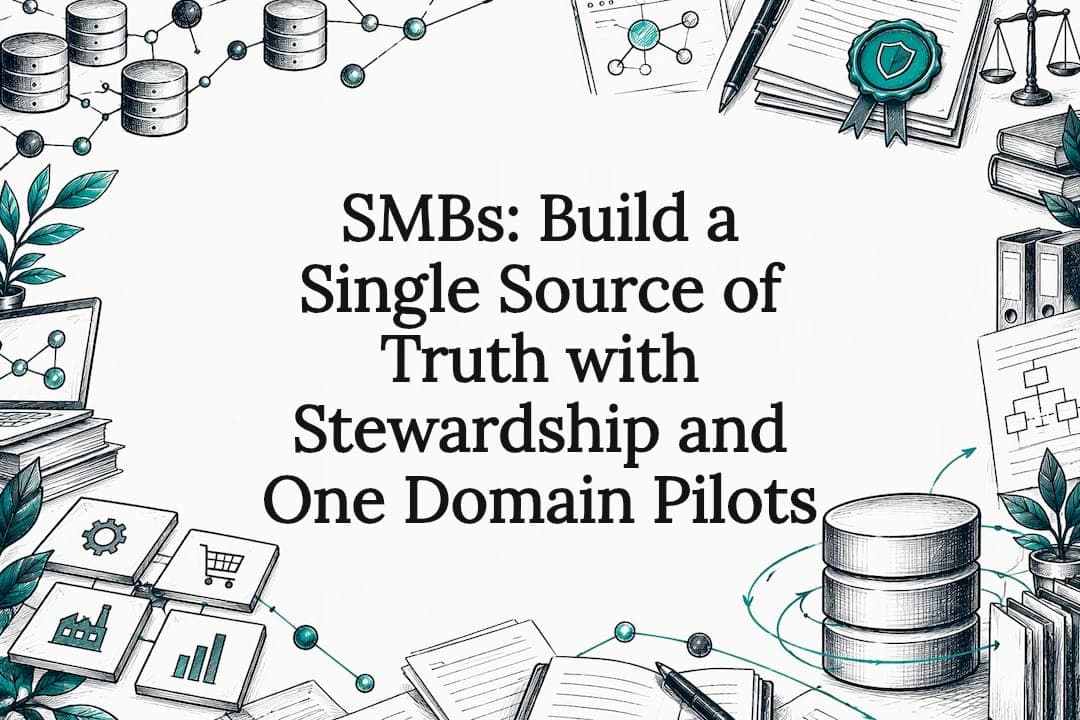
A single source of truth is the one governed place your organisation agrees holds the correct value for a piece of data, whether that's a customer's address or last month's revenue. It matters because it stops teams from arguing over whose spreadsheet is right and gives everyone the same accountable record to work from. The rest of this article walks through what that looks like in practice and how to build one, step by step.
Table of Contents
- What single source of truth means, and how it differs from a system of record
- What benefits and measurable outcomes to expect
- What a single source of truth looks like in practice
- How do you build a single source of truth step by step
- What roles and policies keep a single source of truth working
- What mistakes to avoid when implementing one
- How a custom build can create an SSOT for small businesses
- Why stewardship beats a big rebuild
- How AdaptAI helps small businesses build one connected system
- Where to find the guidance behind this article
- Sources
- FAQ
What single source of truth means, and how it differs from a system of record
A single source of truth, often shortened to SSOT, isn't really a database. It's a governance decision: your organisation names one place as authoritative for a specific piece of data, and everyone agrees to treat that value as correct. Government guidance on data quality frames this as improving findability, accessibility and reuse once terms, codes and formats are consistent across an organisation. The word "governed" is doing a lot of work there. Without an owner and a definition, you just have one more copy of the data, not a source of truth.
People often mix up a few related terms, and the differences matter when you're planning:
- System of record: the operational application where a transaction happens first, like the accounting platform where an invoice is created.
- Master data management: the practice of maintaining consistent core entities (customers, products, locations) across multiple systems.
- Golden record: the single, reconciled version of an entity built by merging and cleaning data from several sources.
- Single source of truth: the governance layer that decides which of those systems or records is authoritative for a given field or use case.
An organisation can, and usually should, have more than one authoritative source. Customer contact details might live in the CRM, while billing addresses live in the accounting system. What matters is that each field has exactly one owner and one agreed value, not that everything sits in a single application.
What benefits and measurable outcomes to expect
The payoff of an SSOT shows up in fewer arguments about numbers and less time spent reconciling spreadsheets. When one team pulls a customer count from the CRM and another pulls a different number from billing, someone has to stop and figure out which one is right. That reconciliation work disappears once a field has a named authoritative source.
The federal data strategy for 2023 to 2026 points to clear stewardship, common standards and accountable roles as the levers that reduce duplication and improve consistency, though it stops short of naming a universal percentage improvement, since outcomes depend heavily on how the standards are applied.
Clear ownership tends to be the biggest unlock. When a data steward is named for customer records, questions about accuracy have somewhere to go instead of bouncing between departments.
You can translate these benefits into KPIs your team will actually track:
- Hours spent per week reconciling reports across departments.
- Number of duplicate customer or product records identified per quarter.
- Time from data request to trusted answer.
- Error rate in reports that feed billing or compliance.
Faster decisions follow naturally once people stop double-checking whose number is right before a meeting even starts.
What a single source of truth looks like in practice
Two scenarios show how this plays out at different scales.
- A small business customer master. The CRM owns the customer's name, contact details and sales stage. The invoicing system owns billing address and payment terms. The scheduling tool consumes both, pulling contact details from the CRM and billing terms from invoicing, rather than storing its own copy. A monthly reconciliation report flags any customer whose contact details differ between systems.
- A public-sector reference standard. Departments that need consistent classification codes, like industry categories or geographic boundaries, rely on a stewarded reference standard rather than each building its own list. This is the kind of stewardship work described in Statistics Canada's data strategy, which treats reference data as shared infrastructure meant to be discoverable and reused rather than recreated by every team.
In both cases, the pattern is the same: authoritative source, then consuming systems, then a reconciliation step that catches drift before it becomes a real problem.
How do you build a single source of truth step by step
Building an SSOT is less about buying a tool and more about making a series of deliberate decisions, in order. The DND/CAF data management and analytics framework lays out a sequence that works just as well for a twenty-person company as it does for a government department: start narrow, define terms before touching systems, and monitor continuously once you're live.
- Inventory your data domains. List where customer, product, financial and operational data currently live, including spreadsheets nobody admits to using anymore.
- Pick one high-value domain to pilot. Customer records or invoicing are common starting points because errors there are visible and costly.
- Define the business terms. Agree on what "active customer" or "completed job" actually means before you write a single line of integration code.
- Assign a canonical ID and an owner. Every record needs one unique identifier and one named person accountable for its accuracy.
- Profile and cleanse the data. Find duplicates, missing fields and inconsistent formats in the pilot domain before connecting anything else to it.
- Map systems and integrate. Decide which systems read from the authoritative source and which are allowed to write to it.
- Build reconciliation and validation checks. Set up a recurring report that flags mismatches between the authoritative source and any system still holding its own copy.
- Document metadata and lineage. Record where each field comes from, how it's calculated and what its limitations are, following the fitness-for-purpose approach in Treasury Board's data quality guidance.
- Set change control. Decide who can create or edit a record, and what approval a change needs before it takes effect.
- Monitor and expand. Once the pilot domain is stable, move to the next one using the same process.
Pro Tip: Run the pilot on the domain your team already argues about most. That's where the payoff will be most visible, and it builds the case for expanding to the next domain.
The order matters more than the speed. Skipping the definition step to get to integration faster is the single most common way these projects stall, because the technical work ends up encoding disagreements that were never actually resolved.
What roles and policies keep a single source of truth working
An SSOT doesn't stay accurate on its own. Guidance on being good data stewards recommends naming specific roles before migration starts, not after something breaks.
- Business owner: accountable for what the data means and how it's used, usually a department lead.
- Data steward: responsible for day-to-day accuracy, resolving conflicts and answering questions about a specific domain.
- Technical owner: manages the systems, integrations and access controls that keep the data flowing correctly.
- Reporting channel: a clear place for users to flag suspected errors, rather than quietly maintaining their own workaround.
Policies need to cover who may create or update a record, how conflicting values get resolved, and how the data aligns with your privacy and security obligations. A federated hub-and-spoke model, where a central team sets standards, but domain owners manage their own data day to day, tends to suit organisations that can't realistically centralise everything. Pair that with a quarterly review cadence so drift gets caught before it compounds.
What mistakes to avoid when implementing one
The most common failure is treating an SSOT as something you buy rather than something you govern. A new platform doesn't create accountability. Assign owners and stewards before you evaluate any tool, not after.
- Pitfall: synchronising systems technically while definitions still disagree. Fix: agree on reference standards and calculation methods first, since documented metadata standards exist precisely because semantic disputes survive technical integration.
- Pitfall: launching without ongoing monitoring. Fix: schedule recurring reconciliation and quality checks rather than treating go-live as the finish line.
- Pitfall: trying to centralise every domain at once. Fix: pilot one domain, prove the reconciliation process works, then expand.
Pro Tip: If a reconciliation report keeps flagging the same mismatch every month, the problem is usually a missing definition, not a broken integration.
How a custom build can create an SSOT for small businesses
For a small or medium business, the domains that usually cause the most friction are customer records, invoicing, scheduling and reporting, each often living in a different tool with its own login, making workflow tools like PostHive helpful for content operations and data integration. A custom-built system can unify those behind one canonical customer or job record, with invoicing and scheduling reading from the same source instead of keeping separate copies. Custom software developers build this kind of system for small and medium businesses, and clients often report saving administrative work hours every week once their data is connected under a single login.
If you're evaluating a developer for this kind of project, a few questions are worth asking upfront:
- Who owns the code and data once the project is delivered, so you're never locked into one vendor.
- Can you export your data in a usable format if you ever need to switch tools.
- Does the engagement include training for your team, not just the software build itself.
- What ongoing support is available once the system is live and your processes evolve.
Why stewardship beats a big rebuild
The organisations that get this right don't run one enormous migration project. They pick a domain, assign a steward, measure the reconciliation gap, and only then decide whether to expand. Treating an SSOT as a finished deliverable is the mistake. It's ongoing stewardship, closer to bookkeeping than to construction, and it needs someone checking the books on a schedule, not a plaque on the wall saying the project is done.
Start smaller than feels comfortable. The metadata and ownership decisions you make in week one will matter more than any integration you build in month three.
— Harry Gill
How AdaptAI helps small businesses build one connected system
Most small businesses don't need an enterprise data platform. They need their CRM, invoicing, scheduling and reporting stopping disagreeing with each other. That's the specific problem AdaptAI builds custom software to solve, consolidating those tools into one application with a single login instead of stitching together off-the-shelf products that were never designed to share data.
A typical engagement starts with a discovery conversation about which domain is causing the most friction, moves into a custom software build around your actual processes, and includes training so your team knows how to use it well. Ongoing AI training and workshops and data analysis and reporting keep the system useful as your business changes, and because you own the code, there's no lock-in if your needs shift. If reconciling numbers across tools is costing your team hours every week, book a discovery conversation with AdaptAI to see what a unified system would look like for your business.
Where to find the guidance behind this article

For readers who want the primary sources, the Treasury Board's guidance on data quality explains fitness-for-purpose thinking, while the DND/CAF data management framework lays out implementation steps in detail. The Government of Canada's 2023 to 2026 data strategy covers stewardship at scale, and Statistics Canada's data strategy shows how reference data is treated as shared infrastructure.
Sources
FAQ
What is a single source of truth?
A single source of truth is the one governed, authoritative place your organisation agrees holds the correct value for a specific piece of data. It's a governance decision about ownership and definitions, not simply a single database, as described in government guidance on data quality.
What is another word for single source of truth?
There isn't an exact synonym, but related terms include "authoritative source," "master record" and "golden record," each describing a slightly different piece of the same idea. A golden record specifically refers to the single reconciled version of an entity built by merging data from multiple systems.
Can you give me an example of a single source of truth?
A common example is a customer record where the CRM owns contact details and sales stage, while the invoicing system owns billing address and payment terms, and other tools read from both rather than keeping their own copies. Public-sector reference standards for classification codes, described in Statistics Canada's data strategy, work the same way at a larger scale.
What is the meaning of source of truth?
"Source of truth" refers to the specific system or record that has been designated as authoritative for a piece of data, meaning other systems should defer to it rather than maintaining conflicting copies. The designation comes from a governance decision, not from the technology itself, according to Treasury Board's data quality guidance.