
Quote-to-cash automation connects the systems that quote, contract, bill, and collect revenue so a deal never has to be manually rekeyed between them. The single biggest payoff is speed: deals close faster and cash arrives sooner, because the same data that built the quote flows straight through to the invoice. Clients report saving a significant amount of administrative work each week once these systems talk to each other, and industry analysts tie broken quote-to-cash processes directly to revenue leakage as companies scale.
Table of Contents
- What is quote-to-cash automation, and how is it different from order-to-cash?
- What are the core stages of the Q2C lifecycle?
- What ROI can you expect from automating quote-to-cash?
- Where do Q2C automation projects usually fail?
- What does a realistic implementation checklist and timeline look like?
- What integration and AI questions should you ask before buying?
- How has this worked in practice? The AutoLedger case study
- What compliance and regulatory factors affect Q2C automation?
- How do you manage change and drive adoption during a Q2C rollout?
- Author perspective: fix pricing and discount data before anything else
- Where to start with AdaptAI for your quote-to-cash consolidation
- Sources
- FAQ
What is quote-to-cash automation, and how is it different from order-to-cash?
Quote-to-cash, often shortened to Q2C, is the full sequence of events from the moment a salesperson builds a price quote to the moment your business collects payment and recognizes that revenue. Order-to-cash, or O2C, is a smaller piece of that sequence. It starts once an order is confirmed and ends at collections, which means O2C is really a subset of Q2C, not a competing framework.
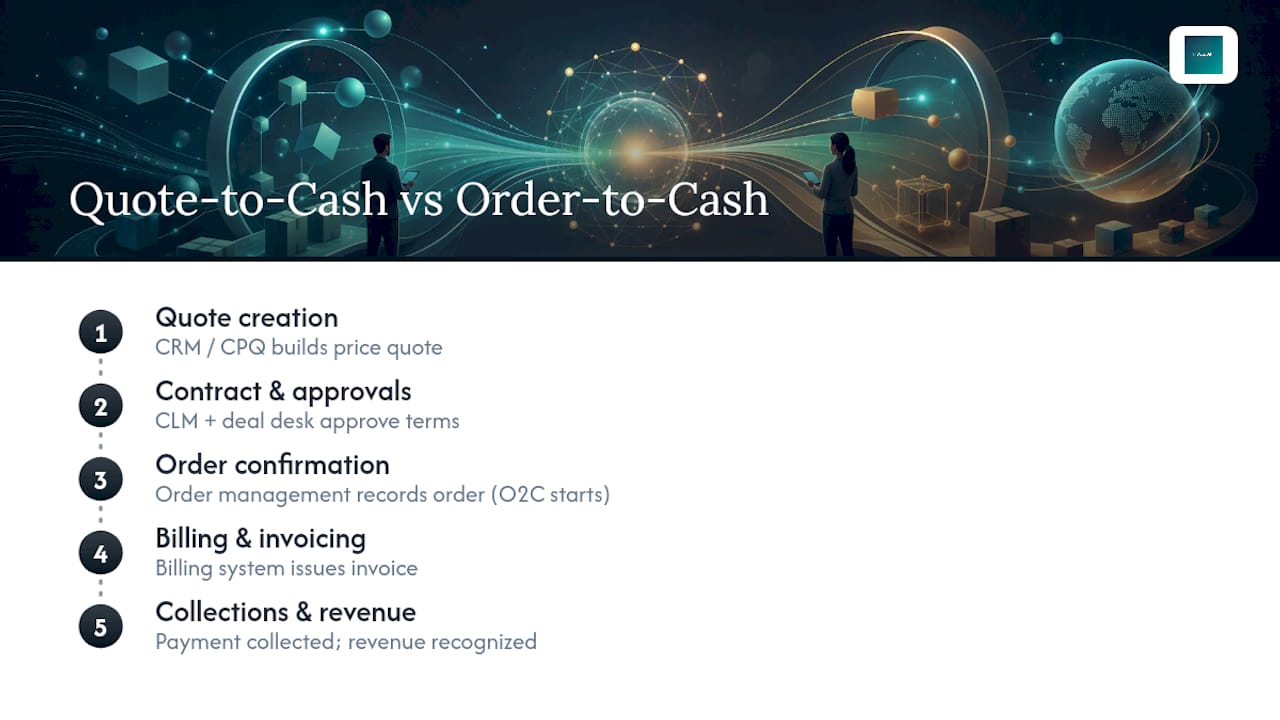
The confusion usually comes from which systems people think of first. Q2C pulls in your CRM, your configure-price-quote (CPQ) tool, contract lifecycle management (CLM), order management, billing, and your ERP or finance stack. A deal desk or finance team typically sits in the middle, approving exceptions.
Here is where it breaks down in practice: a sales rep negotiates a custom discount and a phased payment schedule inside a contract PDF. Nobody transfers those terms into the billing system as structured fields. Three months later, finance issues an invoice based on the list price, the customer disputes it, and someone spends two days untangling a contract clause that should have taken thirty seconds to look up.
What are the core stages of the Q2C lifecycle?
Every Q2C process, no matter the industry, moves through roughly the same stages. Automation adds the most value where humans currently do the most repetitive translation work between systems.
- Configure – the rep builds a quote using approved pricing rules and product bundles.
- Price and discount – discount thresholds trigger automatic approval routing instead of email chains.
- Quote approval – deal desk or manager sign-off happens inside the CPQ tool, not a spreadsheet.
- Contract generation – terms populate from the approved quote instead of being retyped.
- Contract execution (CLM) – e-signature and negotiated redlines get captured as structured data, not just a signed PDF.
- Order creation – the signed contract auto-generates an order without manual entry.
- Fulfillment – provisioning or delivery triggers based on order status.
- Billing and invoicing – invoices generate from the same structured terms, matching what was actually agreed.
- Revenue recognition – finance applies recognition rules automatically based on contract type.
- Collections and renewal – payment tracking and renewal alerts run without someone checking a calendar.
Transactional, low-touch sales see the biggest leverage in steps 1 to 4, where volume is high and terms rarely change. Negotiated enterprise deals see it most in steps 5 to 8, where contract complexity is exactly what causes billing errors downstream.
What ROI can you expect from automating quote-to-cash?
The KPIs that matter to a decision-maker building a business case are quote cycle time, quote-to-order conversion rate, invoice cycle time, days sales outstanding (DSO), dispute rate, and revenue leakage as a percentage of billings. Mature Q2C programs tend to move all six in the same direction: shorter cycle times, fewer disputes, and lower DSO as manual handoffs disappear.
The math is straightforward once you have your own numbers. If your team processes 200 quotes a month and each one currently takes three days to get approved because it sits in someone's inbox, cutting that to same-day approval frees up staff time you can reallocate to closing deals rather than chasing signatures.
Statistic callout: Analysts consistently point to broken Q2C governance, particularly missing controls on discounting and contract terms, as a leading driver of revenue leakage once companies scale past a certain growth threshold. The same manual error that costs a small business a few hundred dollars a year in re-billed invoices can cost a fast-growing company far more once quote volume multiplies.
Track your invoice dispute rate before and after any pilot. It is usually the fastest KPI to move and the easiest one to show a finance leader.
Where do Q2C automation projects usually fail?
Most Q2C projects do not fail because the software is bad. They fail because the underlying data was never structured properly in the first place, so the automation has nothing reliable to act on.
- Unstructured contracts: pricing ramps, multi-element schedules, and custom discounts sitting inside PDF text instead of database fields mean billing cannot be automated without a human reading the contract first.
- Weak discount governance: when approval thresholds are inconsistent or routed by email, discounts slip through without anyone checking them against policy.
- Siloed systems: CRM, CPQ, and billing that don't share a data model force someone to rekey the same deal three times, and each rekey is a chance for an error.
- No segregation of duties: automating a broken approval chain just makes the broken chain faster, which is why internal controls need to be preserved, not skipped, when you redesign the workflow.
Pro Tip: Before you automate anything, run your new workflow against last quarter's actual messy contracts, not a clean demo dataset. If your automation only works on tidy test data, it will fail on the first real negotiated deal.
What does a realistic implementation checklist and timeline look like?
Before you sign a contract with any vendor or agency, map what you already have. Skipping this step is the single most common reason Q2C projects run over budget.
- Process map: document your current quote-to-cash flow, including every manual handoff and spreadsheet workaround.
- Systems inventory: list every tool touching a deal, from CRM to spreadsheets used for approvals.
- Data quality audit: check whether pricing and discount terms already exist as structured fields anywhere.
- Pilot scope: pick one product line or customer segment with negotiable terms rather than trying to automate everything at once.
- Success metrics: define your pilot's target numbers for quote cycle time and dispute rate before you start, not after.
- Pilot window: run the pilot for 8 to 12 weeks, long enough to see a full billing cycle.
- Data model build: map contract fields (pricing, discount schedule, renewal terms) into structured database fields.
- Approval workflow design: rebuild discount governance rules inside the new system, not around it.
- Team training: train the people who will actually use the system daily, not just managers who approved the budget.
- Ongoing support: schedule a review at 90 days to catch edge cases the pilot didn't surface.
A single product line with negotiable terms, mapped to one contract template and one set of database fields, keeps integration complexity contained and gives you clean before-and-after KPIs to show leadership.
What integration and AI questions should you ask before buying?
The technical question that decides whether a Q2C project succeeds is simple: can your pricing and contract terms be captured as structured fields? If pricing tiers, discount schedules, billing frequency, and renewal ramps live only as prose in a contract, no billing system can act on them reliably.
- Direct API integration works well between two systems (say, CPQ and billing) but gets brittle fast once you add a third or fourth system.
- Integration platforms or middleware centralize the connections and are usually the more sustainable choice for businesses running more than two or three core systems.
- Task-specific AI agents are increasingly used for document extraction, pulling pricing and terms out of signed contracts, and for routing exceptions like disputed invoices to the right person automatically.
- Buyer-supplier integration layers matter if your customers use eProcurement systems, since translating structured fields between buyer and supplier systems cuts down on dispute rates.
Any AI agent that executes actions rather than just flagging them for review needs a human-in-the-loop checkpoint, especially around pricing exceptions and contract approvals, where a mistake is expensive. AdaptAI's AI services work through this governance layer with clients before any automation goes live, not after.
How has this worked in practice? The AutoLedger case study
AdaptAI's AutoLedger case study involved a Surrey-based CPA firm running separate tools for client billing, scheduling, and reporting, with staff manually re-entering the same client data across each one. AdaptAI built a custom system that consolidated those functions behind a single login, mapping the firm's billing and client data into one structured model instead of three disconnected spreadsheets and software tools.
A recurring theme across client engagements is the same one that shows up in AutoLedger: once billing, scheduling, and client records share one data model instead of three separate logins, the hours lost to rekeying and cross-checking simply disappear. Clients typically report getting back a significant amount of administrative work per week after implementation.
For a small business, 5 to 15 hours a week is close to a part-time staff position, freed up without a new hire — examples like these show how AI tools for small businesses deliver real ROI by automating repetitive tasks. The lesson from AutoLedger that applies beyond accounting firms: the win comes from consolidating the data model first, then training the team on how to use it, not from bolting AI onto a system that is still fundamentally fragmented.
What compliance and regulatory factors affect Q2C automation?
Tax configuration is the compliance issue decision-makers underestimate most often. In Canada, GST/HST remittance has more than one calculation path, and the CRA's quick method uses a different remittance rate structure than the standard method. If your billing automation hardcodes one calculation approach without checking which method your business actually uses, every automated invoice inherits that error.
Revenue recognition rules add a second layer. Multi-element contracts, the kind with a setup fee, a subscription fee, and an ongoing service component, each need to be recognized on their own schedule, not lumped together. Automating billing before your accounting team agrees on how each component gets recognized just automates the wrong split.
Internal controls matter just as much as tax accuracy. Segregation of duties, meaning the person who approves a discount is not the same person who issues the invoice, is a standard control in receivables management, and that separation needs to survive the move to automation, not get quietly erased because a system now handles the step. Any vendor proposing to collapse approval and execution into one automated step without an audit trail is proposing a control gap, not an efficiency gain.
Build your compliance checklist before your technical checklist. It is far cheaper to fix a workflow diagram than to unwind a year of misconfigured invoices.
How do you manage change and drive adoption during a Q2C rollout?
The biggest adoption risk in a Q2C project has nothing to do with the software. It is sales reps and finance staff quietly reverting to their old spreadsheet the moment the new system feels slower than what they already know.
Start by naming a single process owner, usually someone in RevOps or on the deal desk, who has authority over both the sales-side and finance-side rules. Without one owner, sales blames finance for slow approvals and finance blames sales for messy contract data, and the automation project stalls in the crossfire.
Run the pilot with the actual people who will use it daily, not just their managers. A rep who tests the new quote approval flow on a real deal will surface friction points a manager reviewing a demo never will. Build in a short overlap period where both the old and new process run in parallel, so nobody feels like they lost their safety net overnight.

Training matters more than most timelines allow for. Ongoing AI training is integrated into engagements specifically because a consolidated system only pays off if the team actually uses it the way it was designed, rather than working around it out of habit. Budget for a second training session 30 to 60 days after go live, once people have real questions instead of hypothetical ones.
Author perspective: fix pricing and discount data before anything else
If you only fix one thing in your Q2C process this year, fix discount governance and contract data structure for a single product line. That single change removes the root cause behind most billing disputes and revenue leakage, and it gives you clean before-and-after numbers to show leadership.
Pick one owner, ideally in RevOps or on the deal desk, so accountability doesn't bounce between sales and finance when something breaks. Spend real budget on training before launch, and build a rollback plan for your pilot. A pilot you can reverse without panic is a pilot people will actually trust enough to expand.
— Harry Gill
Where to start with AdaptAI for your quote-to-cash consolidation
Some providers take the piecing together approach of add-ons or middleware subscriptions on top of existing systems; alternatively, a custom system can be built to consolidate CRM, invoicing, scheduling, and reporting behind a single login, structured around how a business actually quotes and bills.
That means the discount governance, contract fields, and billing rules covered in this guide get built directly into your workflow instead of layered on top of it, and ongoing training helps teams to actually use the system once it's live. If you want to see what that looks like in practice, review the AutoLedger case study for a real consolidation project, or compare the build-versus-buy tradeoffs for your own situation. A practical next step is a scoping call where your current quote-to-cash flow is mapped to determine honestly whether a custom build makes sense for where your business is right now.
Sources
- Msdynamicsworld
- Quick method for GST/HST (Government of Canada publication)
- Quote-to-Cash vs Order-to-Cash Explained | TradeCentric
- What is Quote-to-Cash? — ERP Research
FAQ
What is a quote-to-cash process?
It is the complete sequence from building a sales quote through contract signing, order fulfillment, billing, and collections, ending when revenue is recognized and cash is received.
What is the main difference between CPQ and quote-to-cash?
CPQ (configure, price, quote) is one tool inside the Q2C process, handling only the pricing and quoting step; Q2C covers everything from that quote through to final payment and revenue recognition.
What is the difference between Q2C and O2C?
Order-to-cash (O2C) starts at order confirmation and ends at collections, making it a smaller subset of the broader quote-to-cash cycle, which begins earlier at the quoting stage.
What is quote-to-cash in Salesforce?
In Salesforce, quote-to-cash typically refers to CPQ and billing tools layered onto the CRM to handle quoting, approvals, and invoicing, though the underlying Q2C concept applies to any CRM and billing combination, not just Salesforce specifically.
How long does a Q2C automation pilot usually take?
A focused pilot on a single product line or customer segment typically runs 8 to 12 weeks, long enough to capture a full billing cycle and generate real before-and-after KPI data.