
A business rules engine is a decision-execution component that pulls policy and decision logic out of your application code so teams can change rules without redeploying software. Use one when decisions change often, carry compliance weight, or involve enough branching logic that hardcoding them turns your codebase into a maze. If your rules rarely change or you have only a handful of conditions, you probably don't need one yet.
Table of Contents
- What is a business rules engine and what types exist?
- How rule engines execute rules under the hood
- When a BRE makes sense, and when it becomes a liability
- Implementation and governance: what a rollout actually requires
- Where BREs pay off, and how to measure it
- How to evaluate a business rules engine for your project
- What we've seen work in real deployments
- The gap between rules-engine theory and what teams actually need
- Get a rules and workflow system built around how your business actually runs
- Sources
- FAQ
What is a business rules engine and what types exist?
A business rules engine (often shortened to BRE, and sometimes called a rules processing solution or decision engine) evaluates a set of facts against a collection of if-then statements and returns a decision. The technical distinction from ordinary application code matters: in a normal codebase, business logic is buried inside functions and conditionals that only a developer can safely touch. A BRE separates that logic into a repository that a business analyst can read, edit, and version, often without writing a line of code.
Not every rules engine works the same way, and the differences shape how you'll use one.
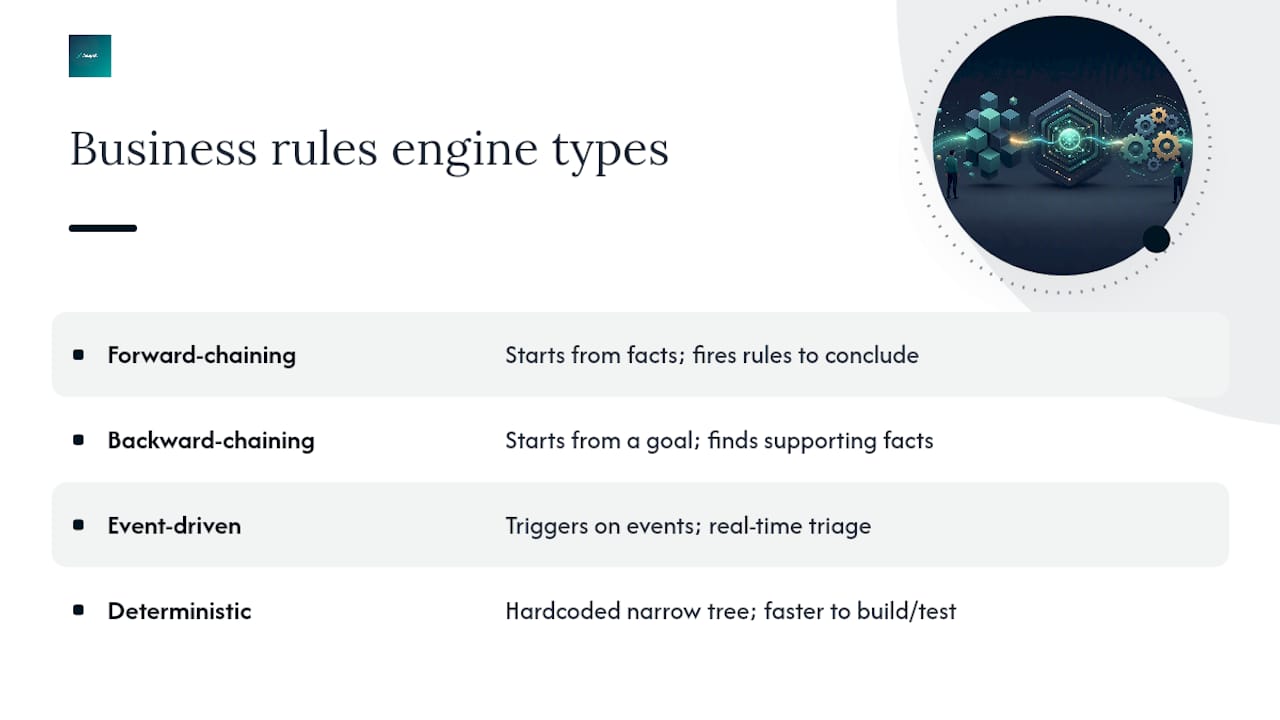
Forward-chaining production engines start from known facts and fire rules until no more apply, which suits scenarios like fraud scoring or eligibility checks where you're building toward a conclusion. Backward-chaining engines work in reverse, starting from a goal and searching for facts that support it, common in diagnostic or advisory systems. Reactive or event-driven engines trigger on incoming events rather than evaluating a static fact base, which fits real-time monitoring and IoT-style triage. Deterministic or domain-specific approaches skip the general-purpose engine entirely and hardcode a narrow decision tree, often faster to build and easier to test when the rule scope is genuinely small.
For authoring, two standards dominate. DMN (Decision Model and Notation) gives business analysts a standardized decision-table format that's portable across vendors. JSR-94 was an early Java specification for rule engine APIs; it's largely legacy now, but its influence shows up in how many Java-based engines still structure their invocation patterns. No-code and low-code platforms have pushed rule authoring further toward business users, letting them build and test rules through visual interfaces rather than code.
How rule engines execute rules under the hood
The mechanics matter because they determine how your BRE behaves under load, and how painful debugging will be when a decision goes wrong.
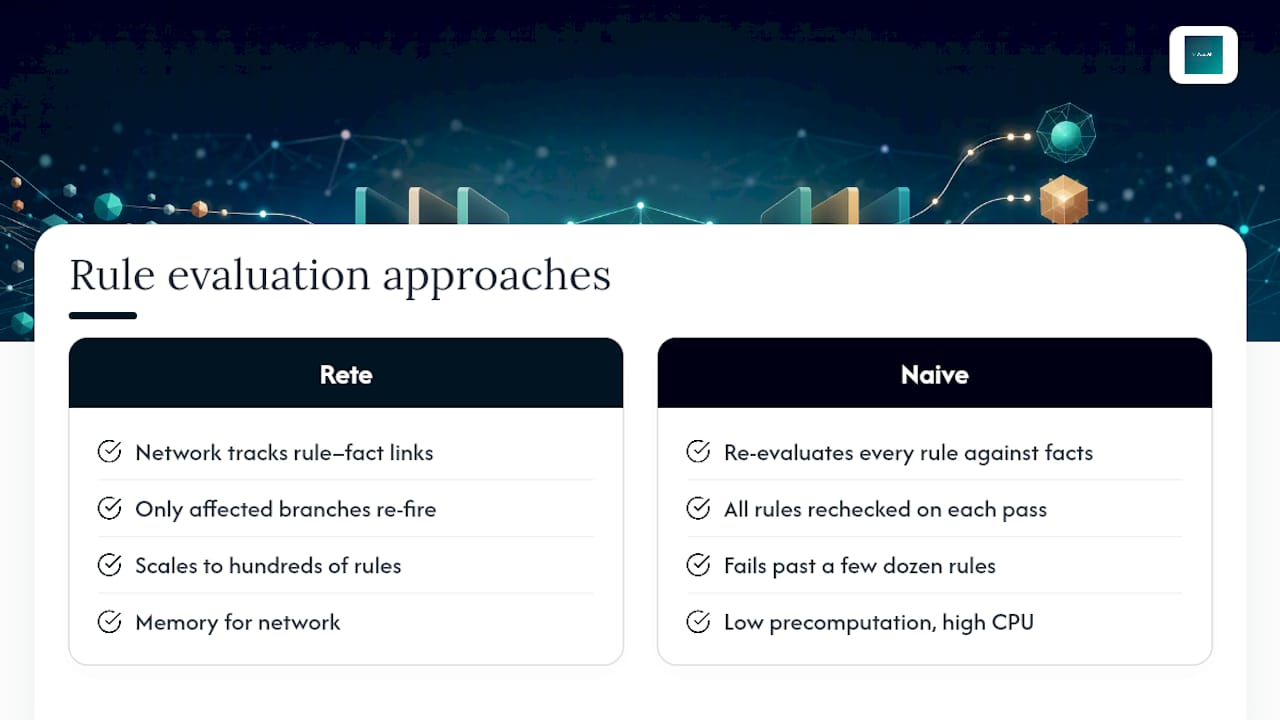
Most production-rule engines use the Rete algorithm to avoid re-evaluating every rule against every fact on each cycle. Rete builds a network that tracks which rules are affected by which facts, so when a fact changes, only the relevant rule branches re-fire. This is why an engine can efficiently evaluate hundreds of rules against a large fact base without grinding to a halt. Without Rete or something like it, a naive engine re-checking every rule against every fact on every pass becomes unworkable past a few dozen rules.
Chaining direction changes what kind of system you're building. Forward chaining answers "given these facts, what follows?" Backward chaining answers "is this goal achievable, and what facts would prove it?" Reactive engines skip both models and simply respond to a stream of events, which is closer to a subscription model than a classic inference engine.
Two runtime concepts trip up teams new to BREs. The agenda is the ordered list of rules waiting to fire, and salience is the priority value that decides firing order when multiple rules could apply to the same facts. This is powerful, but it's also where teams get burned: a change to one rule's salience can silently reorder execution across the entire rule set, creating implicit control flow that's invisible in the code and brutal to debug. If you can't explain why rule 14 fired before rule 9, salience is usually the answer, and it should be documented, not tribal knowledge.
Finally, decide early whether your engine runs stateful or stateless. Stateful sessions retain facts across multiple rule evaluations, useful for long-running processes like a multi-step underwriting workflow, but they carry memory overhead and require explicit session cleanup. Stateless invocations evaluate a fresh fact set every call, which is simpler to reason about and easier to scale horizontally, at the cost of losing context between calls. Latency-sensitive services, like a real-time pricing endpoint, usually favour stateless.
When a BRE makes sense, and when it becomes a liability
A rules engine earns its complexity in a specific set of situations. Frequent rule churn is the clearest signal: if your compliance team wants pricing eligibility rules updated monthly, a BRE lets them do that through a governed interface instead of filing a developer ticket every time. Regulatory and policy automation is another strong fit, since auditors want to see exactly which rule fired and when, something a rules repository handles naturally and scattered if statements do not. Pricing and promotions logic, credit and underwriting decisions, and ticket or claims triage all share the same trait: many small, changeable conditions feeding one decision.
The anti-patterns are just as consistent across failed BRE projects:
- Treating the engine as a home for your entire application logic, not just the volatile decision layer
- Letting rule chains grow so deep that no one can trace why a given output occurred
- Skipping a proof of concept and going straight to a full rollout
- Adding a BRE for logic that changes twice a year, where the governance overhead outweighs the benefit
Martin Fowler's guidance on this is blunt and still holds up: the rules-engine model fits a subset of computational problems, and teams should limit what they push into the engine rather than trying to model an entire application as a rule base. For a narrow, well-scoped decision, a bespoke domain-specific approach can outperform a general-purpose engine on both simplicity and testability.
Before committing, run a proof of concept that specifically measures integration latency and how much effort it takes to map your production data into the engine's fact model. Those two variables are the most common reasons BRE projects stall after the pilot phase.
Implementation and governance: what a rollout actually requires
Getting a rules engine into production is less about picking software and more about building the process around it. Skip the process and you'll end up with a fast decision engine that nobody trusts.
- Choose an integration pattern. An embedded library runs inside your application process, which minimizes latency but ties the rule engine's lifecycle to your app's deployment cycle. A centralized decision service, invoked over an API, decouples rule changes from application releases entirely, letting compliance teams push updates independently. Most organizations moving past a single application choose the centralized model.
- Model your data deliberately. Define canonical facts, the standardized data structures your rules will evaluate, and build explicit mapping and validation between your production systems and that fact model. This is where Rete's efficiency gains can be undone by messy input data.
- Test at three levels. Unit test individual rules in isolation, run regression suites against representative historical data, and simulate decisions in a sandbox before promoting anything to staging.
- Govern the rule lifecycle. Version every rule change, require approvals for production edits, run impact analysis before deployment, and keep audit logs that show which rule fired for which decision. Role-based editing keeps business analysts able to adjust thresholds without touching integration code.
- Operate with observability in mind. Monitor decision latency, log enough context to explain any individual decision after the fact, and build rollback or canary release paths so a bad rule change doesn't hit 100% of traffic immediately.
A business rules management system typically bundles the repository, runtime, and governance tooling together, which is why most teams adopt a BRMS rather than building rule storage and versioning from scratch. Tools that log decision outcomes and keep an audit trail, similar in spirit to how Betlog tracks decision history for wagering, illustrate the broader principle: any system making repeated decisions benefits from a durable record of what happened and why.
Pro Tip: Run your governance rehearsal before your performance testing, not after. Teams that validate the approval and rollback workflow early catch process gaps while stakes are low, instead of discovering them during a live incident three weeks post launch.
Where BREs pay off, and how to measure it
The clearest wins show up in pricing and promotions, where marketing wants to adjust discount thresholds weekly without waiting on a sprint cycle. Underwriting and credit decisioning benefit similarly, since lenders need traceable, auditable logic for every approval or denial. Regulatory compliance enforcement, access control and authorization, and claims or support ticket routing round out the common use cases, all sharing the same underlying need: decisions that change often and must be explainable after the fact.
Track a handful of metrics after deployment rather than assuming success: decision latency, the lead time between a requested rule change and its production release, the number of rule revisions per quarter, and incidents traced back to rule errors. One mid-sized operations team consolidating scattered eligibility logic into a governed rule set cut their rule-change turnaround from weeks to days and reduced manual policy exceptions substantially, the kind of outcome that shows up first in fewer support escalations before it shows up in any dashboard.
How to evaluate a business rules engine for your project
Skip the vendor bake-off until you've nailed down what your team actually needs. The core evaluation axes that separate a good fit from a costly mistake are consistent across projects:
- Authoring model: can business analysts edit rules directly, or does every change require a developer?
- Integration surface: does it offer clean APIs and connectors for your existing stack, or will you be writing custom adapters?
- Governance: does it support versioning, audit logs, and approval workflows out of the box?
- Testing and simulation: can you dry-run a rule change against historical data before it goes live?
- Scalability and latency: does the runtime match your volume and response-time requirements?
- Deployment model: embedded, centralized service, or cloud-managed, and does that match your infrastructure?
Run a focused proof of concept on integration and performance before anything else, then rehearse the governance workflow with actual stakeholders, not just engineers. Model total cost of ownership honestly, including the training and process overhead, since licensing cost is rarely the biggest expense. Weight these criteria against your team's actual skills. A powerful authoring model is wasted if no one on staff will use it.
What we've seen work in real deployments
Custom software firms build systems for small and medium businesses that consolidate scattered decision logic, pricing rules, eligibility checks, approval workflows, into one governed system behind a single login, rather than bolting a generic rules engine onto an already fragmented tech stack. Clients typically report saving significant amounts of administrative work per week once the rules and workflows that used to live in spreadsheets and someone’s memory get consolidated and automated.
The engagement pattern that works best follows a consistent arc: discovery to map existing decision logic, a small proof of concept to validate integration and performance, a fixed-price build, then hands-on training so the team can maintain and adjust rules themselves once the provider moves to a support role. That last step gets skipped too often industry-wide, and it's usually where governance breaks down first.
The gap between rules-engine theory and what teams actually need
Most explainers oversell the technology and undersell the discipline it demands. A Rete-based engine evaluating a thousand rules is genuinely elegant, but elegance in the execution model doesn't fix a poorly scoped rule set, and I'd argue that's where most BRE projects actually fail. It's not the algorithm. It's teams pushing their entire application into the rules layer because the tooling makes it technically possible.
The conventional advice tells you to pick a platform first. The better sequence is to scope your volatile logic first, prototype it with a small POC measuring latency and data mapping, and only then evaluate platforms against that concrete requirement. Fowler's advice to limit scope isn't caution for its own sake, it's the single highest-leverage decision in the entire project.
If you take one thing from this: governance isn't a phase you add later. Teams that treat versioning, audit logs, and approval workflows as day-one requirements ship rule sets that survive contact with real users. Teams that bolt governance on after an incident usually rebuild the whole thing within a year.
— Harry Gill
Get a rules and workflow system built around how your business actually runs
Off-the-shelf rules engines and BRMS platforms are built for enterprises with dedicated rule-governance teams, not a 15-person operations shop that needs pricing logic, approval routing, and reporting to just work together. AdaptAI builds that consolidation directly into a custom system tailored to your actual workflows, so decision logic, scheduling, invoicing, and reporting sit behind one login instead of three disconnected tools stitched together with spreadsheets.
A typical engagement starts small: a short discovery conversation and proof of concept focused on your highest-friction decision points, followed by a fixed-price build and hands-on training so your team can adjust rules themselves once the system is live. If you're weighing whether to buy a packaged tool or build something that actually fits your operation, our breakdown of custom software versus off-the-shelf options is a useful starting point. When you're ready to talk specifics, book a conversation through AdaptAI's workflow automation page and we'll map out what a POC would look like for your business.
Sources
The Martin Fowler piece remains the sharpest scoping advice available. BizTech Magazine explains Rete plainly. IBM covers BRMS architecture, and Microsoft Learn documents a real low-code implementation.
- What is a business rules engine and how does it improve software agility?
- RulesEngine — Martin Fowler
- What is Business Rules Management? | IBM
FAQ
What does a business rules engine do?
A business rules engine evaluates facts against a set of if-then rules and returns a decision, letting teams change policy logic without touching application code. It typically uses an algorithm like Rete to evaluate large rule sets efficiently, and it's most valuable for decisions that change often or need an audit trail.
What are the top business rule engines available today?
There's no single definitive top-ten list, since the right engine depends heavily on your stack, authoring needs, and integration surface, but comparison guides typically group options by deployment model and governance depth rather than treating any one platform as universally best. Evaluate based on your specific volume, latency, and authoring requirements instead of a generic ranking. If you'd rather have decision logic built around your exact workflows instead of adapting your business to a packaged platform, AdaptAI builds that as a custom system.
What does "rule engine" mean exactly?
A rule engine is the runtime component that executes if-then logic against a set of facts to produce a decision, distinct from a rules management system, which also includes the repository and governance tooling around it. Most production engines separate this logic from application code so business analysts can edit rules without a developer redeploying software.
Do I need a business rules engine, or can I hardcode the logic?
If your decision logic changes only occasionally and involves a handful of conditions, hardcoding is usually simpler and easier to test. A BRE earns its complexity when rules change frequently, carry compliance weight, or involve enough branching that a developer becomes a bottleneck for every policy update.
How long does it take to implement a rules engine project?
Timelines vary widely by scope, but a focused proof of concept measuring integration latency and data mapping typically comes before any full build, and that POC stage is where most timeline estimates get corrected. A narrowly scoped rule set, following Fowler's guidance to limit what goes into the engine, moves substantially faster than a project trying to model an entire application's logic.