
An AI readiness assessment measures how prepared your business is to adopt AI across five pillars: strategy, data, infrastructure, governance, and people. It produces a readiness score, a ranked list of gaps, and a recommendation on whether to pilot now or fix foundations first. Most business owners can run a basic version in an afternoon; a partner-led assessment with stakeholder interviews typically runs one to two weeks.
Table of Contents
- What are the core pillars of an AI readiness assessment?
- Try this 10-question AI readiness checklist
- How to run a full AI readiness assessment in two weeks
- How do you evaluate data readiness specifically?
- Turning your score into a 30/90/180-day roadmap
- What an AI readiness assessment actually reveals in practice
- Why continuous monitoring matters more than the first score
- Ready to move past the self-assessment?
- The gap between what these frameworks promise and what actually works
- Sources
- FAQ
What are the core pillars of an AI readiness assessment?
Every credible framework, including Cisco's AI Readiness Index, boils down to a handful of dimensions that determine whether AI sticks or stalls. For small and mid-sized businesses, five matter most.
- Strategy and use-case alignment. Do you have one clearly defined problem AI should solve, and does an executive actually own it? Practical guides consistently flag a single defined use case and executive alignment as the clearest predictor of success.
- Data foundations. Is your customer, sales, or operations data centralized, accurate, and accessible to the people who need it, or is it scattered across five spreadsheets and someone's inbox?
- Tools and infrastructure. Can your existing systems connect through APIs, or is everything a closed box that only talks to itself?
- Governance and security. Do you have basic policies for data privacy, vendor risk, and who approves what an AI tool can touch?
- People and culture. Does your team have basic AI literacy, and is there at least one internal champion who will actually use the new tool rather than quietly ignore it?
A business strong in data and weak in culture needs a different pilot than one strong in strategy but sitting on messy spreadsheets. The pillar that scores lowest usually tells you where your first project should not start.
Try this 10-question AI readiness checklist
Grab a notepad and answer each question yes, no, or partial. This is the fastest way to get a directional score before committing budget to anything bigger.
- Can you name one specific business problem AI would solve this quarter?
- Does a named executive sponsor own that initiative?
- Is your core operational data (customers, orders, scheduling) stored in one system rather than several disconnected ones?
- Can someone on your team pull a clean data export in under an hour?
- Do your current software tools offer APIs or integrations, or are they closed systems?
- Do you have a written policy on what data can leave the business and who approves it?
- Has anyone on your leadership team used a generative AI tool for real work in the last month?
- Do you have a budget line, even a small one, allocated to AI tools or training?
- Would your team describe recent tech changes as "manageable" rather than "chaotic"?
- Have you piloted any automation, chatbot, or AI tool before, even informally?
Score each yes as 10 points and each partial as 5. A result of 0 to 30 signals you are unprepared and need foundation work before any pilot. 31 to 60 means you are developing but have real gaps. 61 to 85 puts you in capable territory, ready for a focused pilot. 86 and above makes you a pacesetter, ready to scale beyond a single use case.
As you score, jot down evidence next to each answer, not just the number. That note becomes your gap list later. The urgency here is real: a 2026 Goldman Sachs survey of 1,256 small business owners found only 14% have actually embedded AI into core operations, despite most having experimented with it. Trying tools and being ready to run them are two different things.
How to run a full AI readiness assessment in two weeks
A self-scored checklist gets you a snapshot. A structured assessment gets you a defensible roadmap you can take to a bank, a board, or your own nerves. Here's a two-week version that mid-sized teams can run themselves or hand to a partner.
- Days 0 to 1: Kickoff. Name the executive sponsor, define what success looks like in plain numbers (hours saved, error rate, response time), and pick the workflow you're evaluating.
- Days 2 to 5: Data audit and tool inventory. List every system currently in use, where data lives, who owns it, and how it moves between tools.
- Days 3 to 7: Stakeholder interviews and skills survey. Talk to the people who'll actually use the tool, not just the people who'll approve buying it.
- Days 8 to 10: Scorecard and gap analysis. Run the full assessment against your five pillars and rank gaps by impact and effort.
- Days 11 to 14: Prioritization workshop and roadmap. Turn the gap list into a 30/90/180-day plan with an owner assigned to each item.
Involve four roles minimum: the executive sponsor, a data owner who knows where the bodies are buried in your spreadsheets, an operations lead who understands the day-to-day workflow, and one external reviewer who has no stake in defending the status quo. That last role matters more than most owners expect. This timeline lines up with what industry data on assessment duration shows: a rough self-assessment takes two to four hours, while a proper partner-led version with interviews and data audits runs one to two weeks.
Pro Tip: Schedule the stakeholder interviews before the data audit finishes. Frontline staff often reveal data problems the audit alone won't catch, like a "master" spreadsheet three people secretly maintain their own copies of.
How do you evaluate data readiness specifically?
Data is where most AI readiness assessments quietly fall apart, and it deserves its own hard look before anything else. Ask five direct questions about the dataset tied to your target use case.
- Is there a single source of truth, or does customer information live in your CRM, your invoicing tool, and someone's memory simultaneously?
- Do you have enough representative examples for the use case, and are they labelled consistently, not just plentiful?
- How current is the data, and how often does it actually refresh? Data that's accurate but three months stale can be worse than no data at all.
- Who can extract the data, and separately, who can edit it? Those are often not the same answer, and that's a governance problem hiding as a data problem.
- What would it take to centralize the two or three tables your target workflow actually depends on?
Don't try to fix everything. Apply an 80/20 filter: focus cleansing effort entirely on the dataset feeding your chosen pilot, and leave the rest for later. Practitioner guidance backs this up directly, suggesting roughly 80% of preparation time should go to cleaning and centralizing data and mapping workflows before any tool gets touched. Automating a broken process just makes the mess move faster. This concern isn't unique to any one business, either. OECD research found many SMEs sit at a basic level of digital maturity and often lack adequate cybersecurity controls, which makes safe AI adoption harder before data problems even enter the picture.
Turning your score into a 30/90/180-day roadmap
Your band determines your pace, not your ambition. A score in the 31 to 60 range means foundation work comes first; jumping straight to a flashy pilot on shaky data almost always backfires.
- 30 days, quick wins: Pick one low-risk, high-value pilot with a defined success metric, small user group, and an exit point if it doesn't work.
- 90 days, foundation work: Fix the data issues you flagged, write a basic governance policy, and run a short team training session so people aren't guessing.
- 180 days, scale: Connect the pilot's tool to your other systems, assign ongoing model or workflow oversight, and build change-adoption checkpoints into regular team meetings.
Judge the 30-day pilot on the metric you set at kickoff, not on vague enthusiasm. If it hits target, move to foundation work with confidence. If it stalls, that's diagnostic information, not failure, and it usually points straight back to a data or culture gap you underweighted in scoring.
What an AI readiness assessment actually reveals in practice
I've reviewed enough of these assessments to notice a pattern: the businesses that score lowest almost never lack ambition. They lack a clean, single source of truth for the workflow they're most excited to automate. The evaluation work often uses a five-dimension model paired with team training that clients report can save 5 to 15 hours of admin work per week after systems get consolidated behind one login. One retail client's assessment flagged fractured scheduling data as the real blocker, not the lack of an AI tool. Fixing that first is what made the eventual pilot work.

Why continuous monitoring matters more than the first score
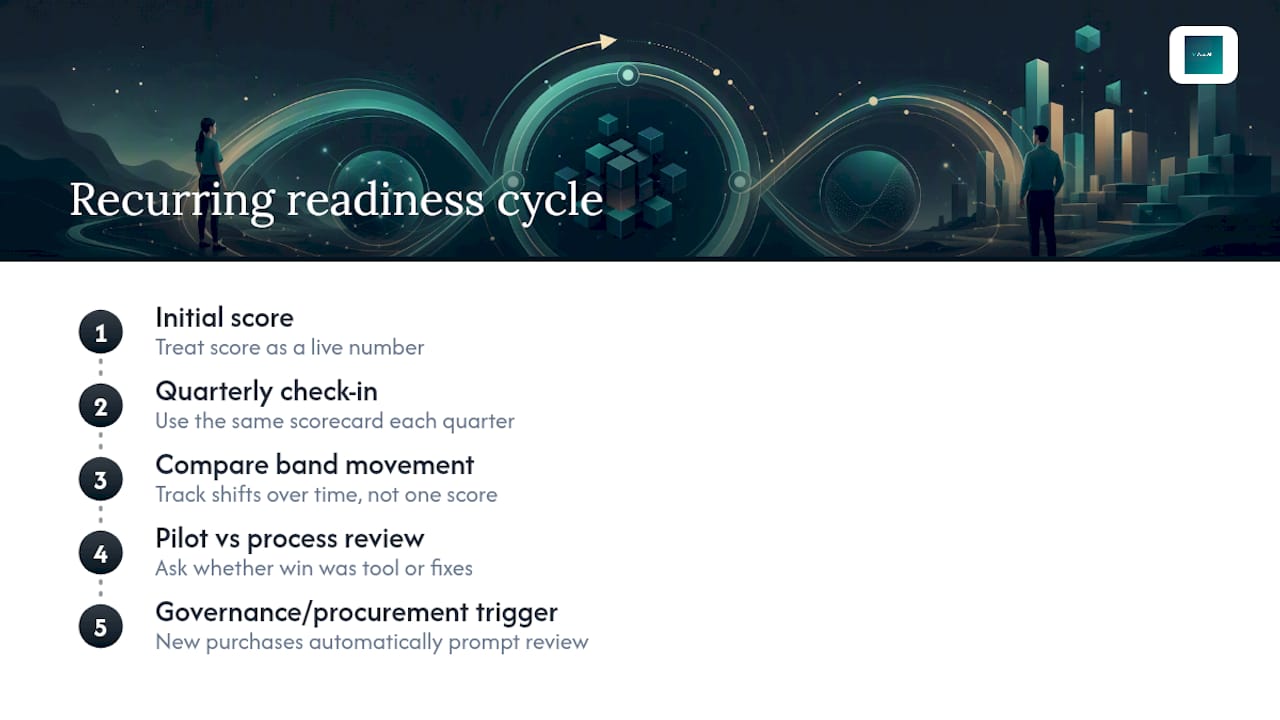
An AI readiness assessment is not a certificate you file away. Treat the score as a live number that feeds your regular business reviews, not a one-time report card. Readiness shifts every time you add a tool, lose a key staff member, or change a process, and a score from six months ago tells you almost nothing about today.
Build a short quarterly check-in around the same scorecard you used initially. Compare band movement over time rather than chasing a perfect score in one sitting. If your pilot succeeded, ask whether the win came from the tool or from the process fixes that happened alongside it, because that distinction determines what you scale next.
Watch for drift in the pillars you scored highest, not just the ones you scored lowest. A team that was AI literate a year ago might have lost its champion to a new job. Governance policies written for one tool often don't cover the next one you adopt. Treating readiness as a fixed state is the single most common mistake leaders make after a first successful pilot, and it's an easy one to correct with a recurring calendar reminder rather than a new project.
Practitioners increasingly recommend folding the readiness score directly into quarterly governance and procurement reviews, so a new tool purchase automatically triggers a fresh look at whether the underlying foundations still hold. That habit costs an afternoon each quarter and saves you from discovering a gap the hard way, mid-rollout.
Ready to move past the self-assessment?
A checklist gets you a directional score. What it can't do is fix the fractured CRM, the three disconnected spreadsheets, or the governance policy you don't have yet. That's where a structured AI readiness assessment from a partner earns its keep, because it turns your gap list into a scoped, fixed-price plan instead of a to-do list nobody owns.
AdaptAI works with small and mid-sized businesses across Surrey and Metro Vancouver to run that assessment, then build the custom software that consolidates CRM, invoicing, scheduling, and reporting behind one login, no separate systems fighting each other. Every engagement includes fixed pricing, local support, and team training built around the tasks your staff actually do, not generic tutorials. If your business consulting needs run toward turning findings into a roadmap rather than just a score, AI strategy consulting picks up exactly where the assessment leaves off. Businesses further along their scaling journey sometimes also work with partners like benchmarked, which focuses on building AI-native organizations once the foundational pieces are in place.
The gap between what these frameworks promise and what actually works
Most AI readiness content oversells the framework and undersells the discipline to act on it. A five-pillar model is genuinely useful, but I've seen businesses score themselves accurately and still fail, because they treated the assessment as the finish line instead of the starting gun.
The conventional advice tells you to "assess, then adopt." The research tells a more specific story: the businesses that actually embed AI, still only 14% by Goldman Sachs' count, are the ones that fix data and process problems before touching a tool, not after a disappointing pilot. Leadership sponsorship matters more than most vendors admit, because a tool with no executive backing dies quietly within a quarter regardless of how clean the data is.
If you take one thing from this framework, take this: score honestly, fix data first, and reassess every 90 days rather than treating the first number as permanent. The businesses getting real value aren't the ones with the best score on paper. They're the ones who kept checking.
— Harry Gill
Sources
- Small businesses embrace AI but need training and support to fully harness it — Goldman Sachs
- Empowering SMEs in the age of AI — OECD (2026)
- Cisco AI Readiness Index — Cisco
- AI Readiness Assessment: The Complete Guide for SMBs in 2026 — ScaleWithMay
FAQ
What is an AI readiness assessment?
An AI readiness assessment evaluates how prepared a business is to adopt AI, typically across five areas: strategy, data, infrastructure, governance, and people. It produces a score, a ranked gap list, and a recommendation on whether to pilot now or fix foundations first.
What is the 30% rule in AI?
If you encountered this term elsewhere, it likely refers to a specific vendor's internal benchmark rather than an industry standard.
What are the core pillars of AI readiness?
The five pillars most SME-focused frameworks use are strategy and use-case alignment, data foundations, tools and infrastructure, governance and security, and people and culture. Cisco's AI Readiness Index uses a closely related six-dimension version that separates talent and culture.
How do you evaluate AI data readiness?
Check whether a single source of truth exists for your target workflow, whether the data sample is representative and well labelled, and how often it refreshes. Also confirm who can extract the data versus who can edit it, since those are often different people and that gap creates governance risk.
How long does an AI readiness assessment take?
A self-scored version can be completed in an afternoon using a basic checklist. A structured, partner-led assessment with stakeholder interviews and a data audit typically takes one to two weeks.