
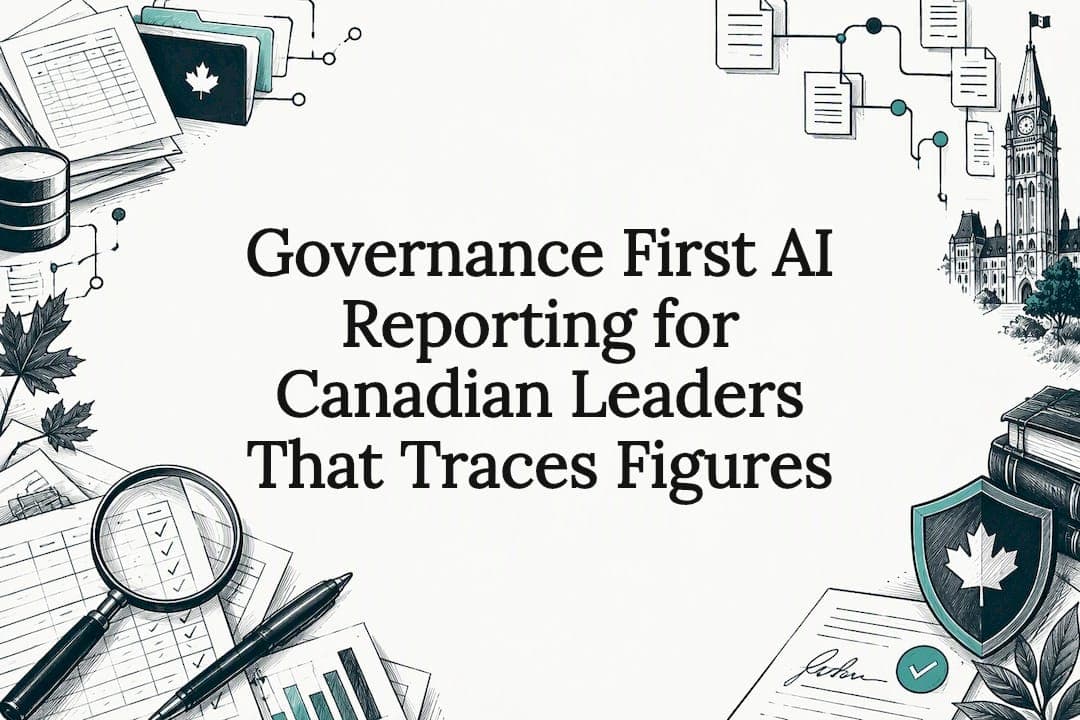
AI can automate and accelerate routine business and technical reports, but only when it's built on authoritative data, locked-down templates, and human review. Skip any one of those three and you get confident-sounding text that's wrong in ways your reviewers won't catch. The first move is to pick one repetitive report, confirm who owns the data and who signs off before publication, then pilot it there.
Table of Contents
- What AI actually does for reporting today
- Why generic generative tools often fail for technical reports
- What to require from any reporting tool or vendor
- A step-by-step way to pilot AI reporting
- How AdaptAI builds this in practice
- Getting your team to actually use these tools
- Keeping AI reports reliable as you scale
- How to know if it's actually working
- A governance-first view for leaders
- How AdaptAI can help
- Where to read the official guidance first
- Sources
- FAQ
What AI actually does for reporting today
AI tools are genuinely useful for the boring, repeatable parts of reporting. They pull structured data from your systems, flag numbers that look off, summarize trends across a quarter, draft the narrative paragraphs around a chart, and answer follow-up questions about a report that's already been approved.
- Data extraction: pulling figures from spreadsheets, databases, or connected apps into a report shell.
- Anomaly detection: flagging a number that jumped or dropped outside its normal range.
- Trend summaries: turning a table of monthly figures into a paragraph a reader can skim.
- Draft narrative: writing the first version of commentary sections a person then edits.
- Chart captions: describing what a graph shows in plain language.
- Report Q&A: letting someone ask a question about an already-approved report instead of re-reading it.
Statistics Canada tracks rising AI adoption among Canadian businesses, with text analytics and data analytics among the most common uses, which lines up with what we see in reporting work specifically. Some businesses report saving 5 to 15 hours of administrative work per week once reporting and other operational tasks run through one connected setup.
None of this is free of risk. Generic AI tools still hallucinate numbers, invent citations, and occasionally treat a guess as a fact. That's the limit you're designing around, not an edge case.
Why generic generative tools often fail for technical reports
A general-purpose chatbot can write a decent paragraph. It's a different problem when the report has fixed sections, numbered appendices, and figures that have to tie back to a source of record. That's where things tend to fall apart, and it's worth knowing exactly how before you hand a tool a real report.
- Structural mismatch: most technical and regulated reports follow a fixed format with tables, appendices, and cross-referenced figures, and a generic model has no sense of that structure unless it's told explicitly, every time.
- Missing provenance: a model can state a figure with total confidence and give you no way to trace it back to the row, file, or date it came from.
- Prompt leakage and retention risk: pasting sensitive operational data into a public tool means you don't fully control where that information goes or how long it's kept.
- Fabricated citations: when asked for a source, a generic model will sometimes produce a plausible-looking reference that doesn't exist.
The Privacy Commissioner's 2026 findings on a joint investigation into OpenAI make a point worth sitting with: fluent language is not evidence of accuracy, and outputs from large language models often lack reliable links back to their source. Before trusting any generated report, compare a handful of its numbers against your system of record and check whether every claim has a traceable origin. If it doesn't, don't publish it.
What to require from any reporting tool or vendor
Before you let a tool near a live report, or sign with a vendor who says they've got this covered, there's a short list of things to confirm. This isn't about picking the flashiest demo. It's about whether the tool can be trusted with a number that someone downstream will act on.
- Authoritative data connections: the tool pulls from your actual systems of record, not a copy-pasted spreadsheet someone updates by hand.
- Template-aware generation: it fills in defined sections rather than free-writing the whole document from scratch.
- Audit logs and source links: every generated figure traces back to the exact row, timestamp, and transformation that produced it.
- Role-based access and retention limits: who can see what, and how long the data sits in the system, are both defined and enforced. Learn more about Security at KEPT for an example of vendor security and trust centre controls.
- Vendor due diligence: ask for representative sample outputs, how errors get caught, whether you're notified when the underlying model changes, and what the rollback plan looks like if something breaks.
The Innovation, Science and Economic Development Canada SME toolkit lays out this kind of risk-based due diligence for smaller businesses specifically, covering accountability, monitoring, and supplier testing. It's worth reading before you sign anything.
Pro Tip: Ask any vendor to show you a report their tool generated from messy, real-world data, not a polished demo. That's where the gaps show up.
A step-by-step way to pilot AI reporting
Don't roll AI reporting out across every report you produce. Start narrow, measure honestly, and expand only once you've proven it holds up.
- Pick one repetitive report and write down its KPIs and exactly which systems the data comes from.
- Build a controlled template that limits the AI to specific sections, such as the summary paragraph or chart captions, not the whole document.
- Test against historical reports you already trust, and check whether the generated version matches the known-correct numbers.
- Log every source and calculation so a reviewer can trace a figure back to where it came from.
- Require a named reviewer to sign off before anything generated goes out the door.
- Set a threshold for scaling up: if error rates and review time stay low across several cycles, expand to a second report; if not, fall back to the manual process and retrain.
Statistics Canada's data on AI adoption suggests businesses see better results from pilots with a fixed scope and a measurable goal, like hours saved per reporting cycle, rather than trying to automate everything at once.
One figure worth building your pilot around: AdaptAI clients typically save 5 to 15 hours a week once reporting and related admin tasks run through a connected, automated setup. That's the kind of benchmark a pilot should be measured against.
How AdaptAI builds this in practice
AdaptAI's approach to AI reporting starts with the same principle as the rest of this article: the report is only as good as the data connection behind it. We build custom integrations so reports generate directly from a business's real systems of record, CRM, invoicing, scheduling, rather than from a manually updated spreadsheet someone has to remember to refresh.
- Reports pull from connected, authoritative data sources instead of copy-pasted exports.
- Clients typically report saving 5 to 15 hours a week on administrative work once their systems and reporting are consolidated.
- Rollouts are controlled and staged, with training built in so teams understand what the AI is doing and why, rather than treating it as a black box.
We also run AI training sessions alongside implementation, because a tool nobody trusts gets ignored, and a tool nobody understands gets misused. The goal isn't a flashy dashboard. It's a report your team can rely on without double-checking every number by hand.
Getting your team to actually use these tools
The tool is the easy part. Getting a team to trust it, and use it correctly, is where most rollouts stall.
Start with the people who currently build the report by hand. They know where the data gets messy and where the current process breaks, and they're the ones who'll spot a wrong number fastest during testing. Bring them in early rather than announcing a finished system.
Run a short training session focused on what the tool does and doesn't do. People need to understand that the AI drafts a section, it doesn't approve the report, and that distinction has to be part of how the workflow is explained, not just written in a policy document nobody reads.
Set a clear rule: no generated report goes out without a named human checking it first. Make that person's sign-off visible in the process, not a quiet step that gets skipped when things are busy.
Expect resistance from people who've seen AI tools overpromise before. The way through that isn't a pep talk, it's showing them a side-by-side of the old manual report and the new one, with the same numbers, produced faster. Let the comparison do the convincing.
Revisit training every time the underlying tool or template changes. A team trained on version one of a reporting workflow will make mistakes on version two if nobody tells them what changed.
Keeping AI reports reliable as you scale
A pilot that works on one report doesn't automatically work on ten. Scaling AI reporting means thinking about maintenance from the start, not bolting it on after something breaks.
Each new report type needs its own template, its own defined data sources, and its own reviewer, even if the underlying tool is the same. Treating every report as identical is how errors slip through: a finance report and an operations report pull from different systems and carry different risks if a number is wrong.
Models change. When a vendor updates the underlying AI model, outputs can shift in ways that aren't obvious until someone notices a report reads differently or a figure doesn't match. Build in a habit of spot-checking after any known model update, and ask vendors to notify you when changes happen.
Data sources change too. A system migration, a renamed field, or a new CRM can quietly break the connection a report depends on. Regular reconciliation checks, comparing a sample of generated figures against the source of record, catch this before a wrong number reaches a decision-maker.
Plan for a manual fallback. If the automated pipeline fails or a data source goes down, someone needs to know how to produce the report the old way, at least temporarily. Losing that capability entirely is a bigger risk than the AI tool failing once.

How to know if it's actually working
The honest way to judge an AI reporting tool isn't whether it sounds polished. It's whether the numbers are right and the process is faster than before.
Track factual error rate: how often does a generated figure not match the source of record, measured across a sample of reports each cycle. Track review time: how long it takes a named reviewer to check a generated report versus how long it took to build the old one by hand. Track time-to-publish: the gap between when data is available and when the final report goes out.

Watch for drift over time, not just at launch. A tool that performs well in week one can degrade if the underlying data changes shape or a model update shifts behaviour. Regular sampling, not a one-time check, is what catches that.
Pair the quantitative numbers with a qualitative one: does the reviewer trust the report enough to sign it without re-doing the work themselves? If reviewers are quietly rebuilding the report from scratch every time, the tool isn't saving anyone anything, whatever the hours-saved figure claims.
A governance-first view for leaders
The mistake I see most often isn't choosing the wrong tool, it's skipping the boring governance work because the demo looked convincing. OSFI's guidance puts it plainly: treat AI output as an input to a decision, not the decision itself, and that means human validation of the data, the calculations, and the conclusions before anything material goes out.
Build that literacy at the senior level first, not just among the people typing prompts. If you can't yet show where a number came from or how you'd roll back a bad report, that's your answer: delay production use until you can.
— Harry Gill
How AdaptAI can help
If you're weighing a generic AI tool against something built for how your business actually works, that's the real choice in front of you. AdaptAI builds custom software that connects your reporting directly to your CRM, invoicing, and scheduling data behind one login, so reports pull from a system you actually own, with no lock-in.
We offer AI workflow automation, data analysis and AI reporting, and hands-on training workshops for teams adopting these tools. Book a discovery sprint to see what a pilot would look like for your reports.
Where to read the official guidance first
Before deploying, check Canada's generative AI guidance, the ISED SME toolkit, and the Privacy Commissioner's findings on model accuracy.
Sources
- Canada
- PIPEDA findings #2026-002: Overview of the joint investigation of OpenAI OpCo, LLC — Office of the Privacy Commissioner of Canada
- Toolkit for SMEs deploying AI — Innovation, Science and Economic Development Canada (ISED)
- Generative and agentic artificial intelligence: Implications for technology, cyber security and operational resilience — OSFI
FAQ
Which AI tool is best for reporting?
There's no single best tool. It depends on whether the reporting connects to your actual systems of record, uses controlled templates, and logs provenance for every figure, which matters more than brand name.
How can I use AI for reporting?
Start by picking one repetitive report, defining its KPIs and data sources, and letting AI draft limited sections like summaries or chart captions rather than the whole document. Test against historical reports you trust and require a named reviewer to approve anything before it's published.
What is the 30% rule in AI?
Definitions vary depending on context, so treat any specific percentage claim you see elsewhere with caution unless it's tied to a named source.
Can ChatGPT be used for report writing?
General-purpose tools like ChatGPT can draft narrative sections or summaries, but they lack built-in connections to your data and don't automatically provide provenance for figures, which the Privacy Commissioner's findings flag as a real accuracy risk. Any output still needs human verification against the source of record before it goes into a real report.